

Orthodontic Insurance Coverage Canada Explained: Tips for Invisalign
Table of Contents
- Understanding Orthodontic Insurance Coverage in Canada
- Key Concepts of Orthodontic Insurance in Canada
- In‑Depth Look at CDCP and Orthodontic Coverage
- Maximizing Your Invisalign Insurance Benefits and Reducing Costs
- Using Health Spending Accounts for Orthodontic Treatment
- Common Questions About Orthodontic Insurance
- Plan Your Orthodontic Journey with Confidence
Understanding Orthodontic Insurance Coverage in Canada
Now that you know the options available, let’s talk about how insurance can help cover the cost. Understanding orthodontic insurance coverage in Canada can feel complex, but we are here to help you make sense of your benefits.
Most private dental plans in Canada provide orthodontic coverage under a separate lifetime maximum, typically ranging from $2,500 to $4,000. According to the Canadian Dental Association, these plans often cover 50% of eligible treatment costs after your deductible is met, up to that lifetime cap. Medically necessary procedures—such as correcting a severe overbite or crossbite—are more likely to qualify for coverage than treatments deemed purely cosmetic.
When weighing Invisalign vs braces cost in Canada, your insurance plan may cover both options similarly if they fall under orthodontic benefits. However, the Canadian Dental Association recommends checking whether your policy has a specific Invisalign allowance. Government of Canada resources confirm that provincial health plans generally do not cover routine orthodontic care, making employer-sponsored private insurance the primary funding source for most families.
Keep in mind that many plans include a waiting period of 6 to 12 months before orthodontic benefits become available. Coverage details vary by province and plan, and the Canadian Dental Association provides helpful guidelines on what constitutes necessary orthodontic care.
We believe in personalized dental solutions and complete dental care all under one roof. Understanding your coverage is the first step — next we’ll explore flexible payment options like Invisalign payment plans in BC.
Key Concepts of Orthodontic Insurance in Canada
Now that you have a clearer picture of the treatment options available—whether traditional braces or Invisalign—the next step is figuring out how to pay for them. For many patients, navigating insurance is the most confusing part. When comparing dental insurance orthodontic coverage in Canada, it helps to understand the main plan types that may contribute toward braces or Invisalign treatment. Orthodontic insurance coverage in Canada varies widely based on the type of plan, your province, and whether treatment is considered medically necessary.
The following table provides a side-by-side overview of the four primary dental insurance plan types available to Canadians.
| Plan Type | Orthodontic Coverage? | Typical Lifetime Maximum (CAD) | Common Restrictions |
|---|---|---|---|
| Canadian Dental Care Plan (CDCP) | No (excludes purely cosmetic orthodontics; may cover limited cases if deemed medically necessary) | $0 for orthodontics under 2025 guidelines; potential future changes under review | Eligibility based on income; renewed annually; adult orthodontics not covered unless specific criteria met |
| Employer-Sponsored Group Plans | Often includes orthodontic coverage for dependents and sometimes adults | $1,500 – $3,500 (varies widely) | Lifetime maximum applies; waiting periods (6-12 months) common; co-insurance of 50% typical |
| Individual/Private Plans | May offer optional orthodontic rider for an extra premium | $1,500 – $2,500 | Age limits (often under 19 only); waiting periods up to 12 months; strict pre-authorization |
| Health Spending Account (HSA) | Yes – eligible expense if orthodontics are prescribed | Depends on employer-allocated funds (typically $500–$2,500/year) | Must be prescribed by a dentist; claims submitted via CRA rules; unused amounts may not carry over |
The Canadian Dental Care Plan (CDCP) currently excludes purely cosmetic orthodontics. According to the Canadian Dental Association, the 2025 guidelines provide no dedicated lifetime maximum for orthodontic care, though very limited coverage may apply if treatment is deemed medically necessary. The program requires income-based eligibility and annual renewal.
Employer-sponsored group plans are among the most common sources of orthodontic benefits. These plans often cover dependents and sometimes adults, with lifetime maximums typically ranging from $1,500 to $3,500 CAD. A 50% co-insurance split is standard, meaning the plan reimburses half the eligible cost up to the cap, and waiting periods of 6 to 12 months are common before you can claim. Because the Invisalign vs braces cost Canada can range from $2,500 to $8,000, a $3,500 lifetime maximum can cover a meaningful share of your expenses. BC residents should also confirm whether their employer offers a province-specific health spending account that can supplement standard orthodontic coverage.
These employer benefits can significantly offset the cost of treatment, but you still need to budget for the remaining portion. The infographic below compares three of the main insurance types side by side.
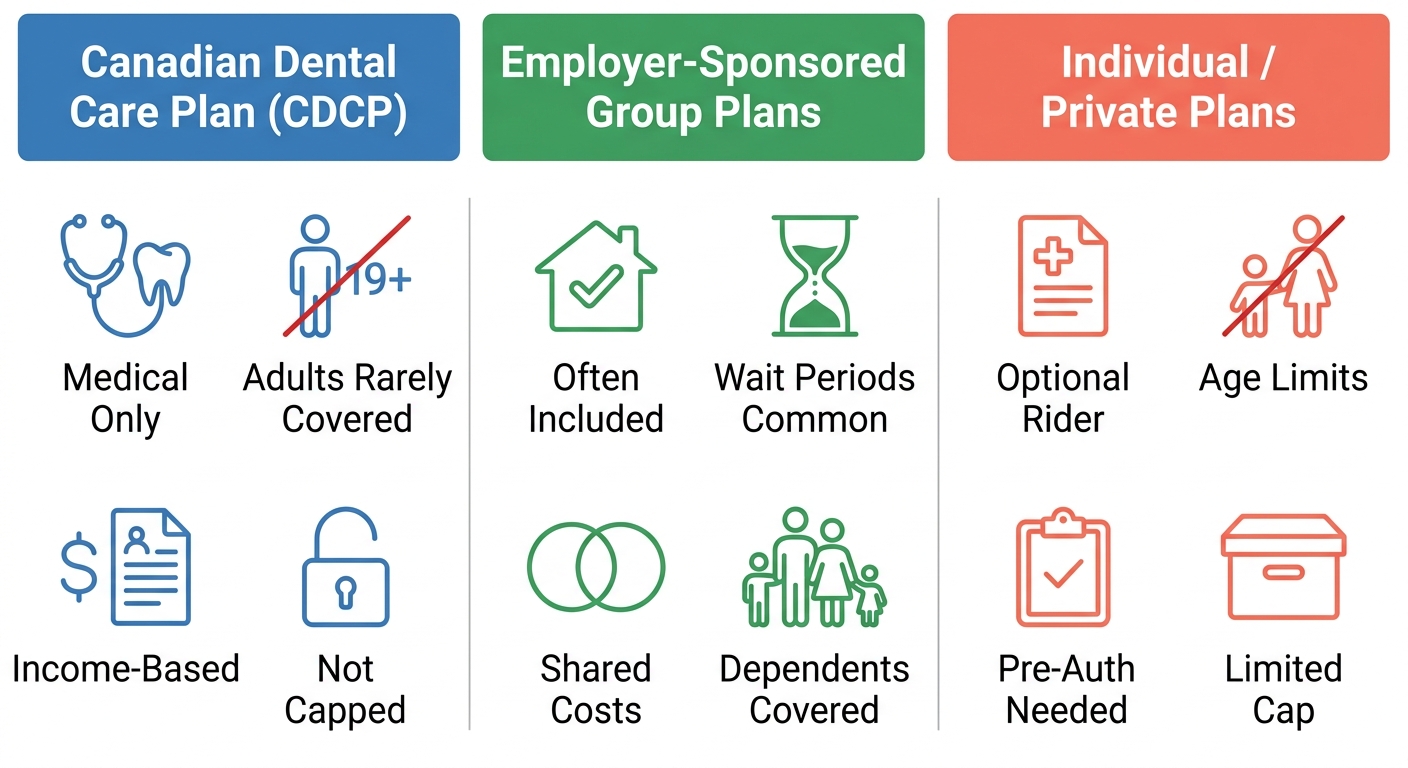
Individual and private dental plans may offer an orthodontic rider for an extra premium. These riders typically come with age limits—often only covering patients under 19—a waiting period of up to 12 months, and strict pre-authorization. Even with the rider, lifetime maximums usually fall between $1,500 and $2,500 CAD.
Health Spending Accounts (HSAs) treat orthodontic treatment as an eligible expense when prescribed by a dentist. The annual limit depends on your employer’s allocation, often between $500 and $2,500 CAD. Because claims follow Canada Revenue Agency rules, you can combine your HSA with the flexible Invisalign payment plans BC residents often use to manage out-of-pocket costs.
Understanding the key concepts of orthodontic insurance in Canada puts you in a better position to plan for treatment. At Parkside Dental Group, we verify your coverage before you start, handle direct insurance billing, and can discuss payment solutions that bridge any gap. We’re here to help you get the smile you want without financial stress.
In-Depth Look at CDCP and Orthodontic Coverage
For many families, figuring out how orthodontic insurance coverage in Canada works means getting familiar with the Canadian Dental Care Plan (CDCP). This federal program aims to make essential dental care more affordable, but its orthodontic benefits come with specific rules and limits. In the sections that follow, we break down exactly what the CDCP pays for when it comes to braces and Invisalign®, how lifetime maximums and co-insurance shape your out-of-pocket spending, and the pre-authorization steps you need to take before treatment begins.
CDCP Orthodontic Coverage for Adults and Children
A common starting question is, “What orthodontic treatment does the CDCP actually pay for?” Health Canada’s official policy makes it clear that orthodontic benefits are reserved almost entirely for children who have a genuine medical need—cosmetic straightening alone doesn’t qualify. The table below gives you a quick snapshot of how the plan treats the most frequent scenarios.
| Treatment | CDCP Coverage? | Patient Contribution / Co-Pay | Notes |
|---|---|---|---|
| Braces for children under 18 | Covered if deemed medically necessary (e.g., severe malocclusion, functional impairment) | Based on CDCP fee guide; patient may owe any difference above guide rates | Pre-authorization required; coverage is not automatic |
| Braces for adults (19+) | Generally not covered unless exceptional medical need demonstrated | Full out-of-pocket likely | CDCP primarily focused on essential dental services; cosmetic orthodontics excluded |
| Invisalign for adults | Not covered as a standard benefit; may be considered if used for a medically necessary correction | Practitioner sets own fee above CDCP guide; patient pays full difference | CDCP fee guide does not list Invisalign-specific codes; provider and patient must agree on cost |
For a child under 18, braces are only approved when there is clear evidence that the misalignment is causing functional problems—things like trouble chewing, speaking, or keeping teeth clean. A well-documented diagnosis of severe crowding or a significant bite issue is typically required, and the treatment plan must be submitted for pre-authorization before anything starts. For adults 19 and older, the bar is set very high. Exceptional medical circumstances (that go well beyond wanting a straighter smile) are needed, so most adult orthodontic care is excluded from CDCP funding.
Invisalign adds another layer of complexity. Because the CDCP fee guide doesn’t include codes for clear aligner therapy, any Invisalign treatment—even when it addresses a medically necessary correction—will almost always leave the patient paying the full difference between the government’s contribution and the provider’s actual fee. We always recommend discussing costs openly with your dentist so you know exactly where you stand before committing to treatment.
Calculating Lifetime Maximums and Co-Insurance
Even when orthodontic insurance coverage in Canada does apply, understanding your financial responsibility means getting comfortable with two concepts: lifetime maximums and co-insurance. Most private dental plans cap what they’ll pay for orthodontics over a patient’s lifetime, often in the $5,000–$10,000 range, and the CDCP may coordinate benefits or restrict coverage to a single course of treatment.
Co-insurance is the part you pay after the insurance contribution. Under the CDCP, the government pays a set percentage of the applicable fee guide, and you cover whatever amount the dentist charges above that guide rate. For example, if the fee guide allows $5,000 for a medically necessary set of braces for a child and your dentist charges $6,200, you would be responsible for the $1,200 difference—regardless of the CDCP’s own payment. When weighing Invisalign vs braces cost in Canada, it’s smart to note that clear aligner fees often sit further outside the fee guide, potentially leaving a larger gap for you to bridge. Discussing these numbers with your dental team early helps you budget realistically and avoid surprises down the road.
Navigating Pre-Authorization for Orthodontic Treatments
Before the CDCP will release any funds toward orthodontic care, a pre-authorization request must be submitted and approved. Skipping this step all but guarantees a denied claim. At Parkside Dental Group, we guide patients through the paperwork so nothing gets overlooked.
A complete pre-authorization package typically includes:
- Recent diagnostic records (panoramic X-rays and intra-oral photographs)
- Study models or digital scans showing the current bite
- A detailed treatment plan with fees and estimated duration
- A narrative from the dentist explaining the medical necessity of the proposed care
Once submitted, it usually takes between two and four weeks to receive a decision from the CDCP administrator. Any missing piece—like an incomplete clinical narrative—can delay approval or lead to denial outright, so we stress the importance of getting everything right the first time. After initial approval, patients must stay on top of CDCP annual renewal requirements to ensure uninterrupted coverage, because a lapse in benefits could mean paying for ongoing adjustments out of pocket.
For adults whose Invisalign treatment isn’t covered, exploring Invisalign payment plans in BC becomes the next logical step. Our clinic works with each patient to structure a plan that fits comfortably within their budget. If the CDCP doesn’t fully cover your orthodontic needs, we offer flexible payment options for Invisalign—schedule a free consultation to explore your options. As a practice that believes in complete dental care, all under one roof, we’re here to provide personalized dental solutions that keep your family smiling.
Maximizing Your Invisalign Insurance Benefits and Reducing Costs
Once you’ve decided that clear aligners are the right choice for your smile, the next important step is making treatment affordable. Understanding orthodontic insurance coverage in Canada and exploring flexible payment strategies can greatly reduce the overall cost of your Invisalign journey in British Columbia. Here’s how our team at Parkside Dental Group helps you maximize your benefits.
Step-by-Step Guide to Verifying Your Invisalign Coverage
Navigating dental insurance jargon can feel overwhelming, but a few straightforward actions will give you clarity.
- Gather your insurance card and policy booklet. Look for the “Orthodontic” section to see if adult orthodontics is covered. Key figures to track include your plan’s annual deductible, the co-insurance percentage (usually 50% to 80%), and the lifetime orthodontic maximum—often between $1,500 and $3,500.
- Call your insurer’s member services line. Ask specifically: “Is Invisalign classified as orthodontic, and what percentage of eligible expenses will you reimburse?” Also confirm any waiting periods or age restrictions.
- Request a predetermination. This pre-treatment estimate tells you exactly what your plan will pay. We can submit the paperwork for you—many Squamish patients use Pacific Blue Cross, and we’re experienced with the process.
- Review your Explanation of Benefits (EOB). When the predetermination comes back, read it carefully to confirm the approved amounts. If anything is unclear, our administrative team is happy to walk you through it.
Every plan is different, so always verify with your own provider—even a small detail like a one-year waiting period can affect your timeline.
Estimating Your Out-of-Pocket Costs with Insurance
Let’s walk through a real-world example so you can see the math in action. Suppose your Invisalign treatment is quoted at $5,500. After the consultation, the eligible treatment amount (excluding fees for things like retainers that some plans don’t cover) is $5,000. Your policy has a $500 deductible, covers 50% of eligible expenses, and carries a $3,000 lifetime orthodontic maximum.
First, subtract the deductible: $5,000 – $500 = $4,500. Then apply the 50% co-insurance: $4,500 × 50% = $2,250. Because $2,250 is well below the lifetime cap, your insurance would contribute $2,250. Your remaining balance would be $3,250.
Actual costs depend on the complexity of your case. According to our clinical experience in Squamish, Invisalign treatment typically ranges from $4,800 to $6,400, while traditional braces cost between $3,800 and $5,200.
When you compare Invisalign vs braces cost Canada data reveals that insurance parameters often apply similarly to both options, as the table below illustrates.
| Cost Component | Invisalign (CAD) | Traditional Braces (CAD) | Insurance Coverage (Typical) |
|---|---|---|---|
| Initial consultation & records | $0–$150 (free consult often offered) | $0–$150 | Usually not covered; deducted from annual visit maximum |
| Aligners / brackets & wires | $4,500 – $7,000 | $3,500 – $6,000 | 50-80% of eligible amount up to lifetime orthodontic maximum (often $1,500–$3,500) |
| Adjustment/monitoring visits | $150-$300 every 6-8 weeks | $150-$300 every 6-8 weeks | May be subject to annual maximum for basic services; orthodontic visit codes often covered at 50-80% |
| Retainers post-treatment | $300 – $600 | $300 – $600 | Usually excluded from orthodontic maximum; may fall under basic preventive if submitted as a separate claim |
The comparison shows that while Invisalign aligners may have a slightly higher upfront price, insurance coverage applies in a remarkably similar way. The potentially shorter treatment time can partially offset the overall expense. Your out-of-pocket investment will ultimately depend on your plan’s details and the complexity of your alignment needs. For a detailed breakdown of aligner costs and the BC Dental Fee Guide, refer to our FAQ on Invisalign cost in British Columbia 2026.
Exploring Payment Plans and Financing in BC
Even with insurance, the remaining balance can feel significant. That’s why we offer flexible payment options designed for families in Squamish and throughout the Sea-to-Sky corridor. When you need Invisalign payment plans BC residents can count on, we provide several routes to make treatment affordable.
Our clinic offers monthly instalment plans that spread your balance over 12 to 24 months, often at 0% interest for well-qualified patients who pay in full. If you prefer third-party financing, trusted providers like Medicard and Dentalcard offer extended terms and competitive rates, giving you the flexibility to choose a monthly payment that fits your budget.
We also simplify the process with direct insurance billing. We submit claims on your behalf immediately after your visits, which reduces the upfront amount you need to pay while you wait for reimbursement. By combining a payment plan with your insurance coverage, many patients can start treatment with little to no down payment.
We understand that orthodontic treatment is an investment, and we treat each patient as we would our own family by helping you find a personalized dental solution that aligns with your financial comfort. Once your financing is in place, you’re ready to begin your Invisalign journey with confidence.
Using Health Spending Accounts for Orthodontic Treatment
Once you’ve explored your orthodontic treatment options, using a health spending account orthodontics in Canada can help cover your expenses. Navigating orthodontic insurance coverage in Canada can be confusing, but an HSA is an employer-funded benefit that lets you pay for braces and Invisalign with pre-tax dollars, making it a valuable supplement to traditional dental insurance.
According to the Government of Canada, orthodontic treatment prescribed by a dentist qualifies as an eligible medical expense under CRA guidelines, making HSA reimbursements tax-free. Because an HSA is employer-funded, you don’t pay monthly premiums; you simply use your allocated balance on services like braces, Invisalign, or even orthodontic consultations and adjustments. Unlike many dental insurance plans that impose age limits or annual caps, HSAs are typically available to all employees, making them a valuable option for adult orthodontics. While comparing Invisalign vs braces cost in Canada might feel overwhelming, an HSA can offset a significant portion of those fees, and it also covers deductibles and co-pays that insurance may not fully pay.
To help you see these differences clearly, the table below contrasts a Health Spending Account with traditional dental insurance for orthodontic coverage.
| Feature | Health Spending Account (HSA) | Traditional Dental Insurance |
|---|---|---|
| Orthodontic eligibility | Eligible if prescribed by a dentist; widely accepted for braces, Invisalign, and related services | Depends on plan; many exclude adult ortho or impose strict age limits |
| Funding source | Employer-funded allocation; employees choose how to spend | Pooled premiums paid by employer and employee |
| Tax implications | Reimbursements are tax-free when used for eligible medical expenses; contributions are employer-paid | Benefits are generally not taxable; premiums paid by employer may be a taxable benefit |
| Carry-forward of unused funds | Usually not permitted; use-it-or-lose-it within the plan year | Lifetime orthodontic maximums are fixed; annual maximums may reset |
As the table shows, HSAs offer a tax-advantaged way to fund orthodontic treatment, free from typical insurance restrictions. You can pair your HSA with interest-free payment plans to cover treatment costs fully. To maximize your HSA, review your employer’s plan details and CRA guidelines, and consider using a balance of $500 to $2,000 to cover deductibles or any remaining out-of-pocket costs. Many patients combine their HSA with insurance to fill coverage gaps, ensuring they can afford the treatment they need.
At Parkside Dental Group, we accept HSAs and can help you maximize your benefits. We offer flexible Invisalign payment plans in BC and provide personalized dental solutions all under one roof. Contact us for a free consultation to explore how your HSA can support your orthodontic care.
Common Questions About Orthodontic Insurance
We answer some common questions about orthodontic insurance coverage in Canada.
Does the BC Dental Fee Guide cover Invisalign? The BC Dental Fee Guide from the College of Dental Surgeons of BC excludes orthodontic treatments like Invisalign, so costs differ by clinic. We provide personalized estimates after an exam.
How does orthodontic insurance work? Orthodontic benefits vary by plan, with annual maximums and waiting periods. While comparing invisalign vs braces cost in Canada helps, confirming your coverage details is key. We can submit pre-authorizations and handle direct billing.
Are there payment plans available? Some insurance covers a portion of treatment, and we assist with pre-authorization. For benchmarks, see Invisalign payment plans in British Columbia from the College of Dental Surgeons of BC. We’ll help explore options.
Understanding your financial options makes orthodontic care stress-free. Before starting treatment, check your orthodontic insurance coverage Canada by reviewing your provider ID to confirm what is covered; the Government of Canada offers helpful healthcare context for understanding your plan. When comparing invisalign vs braces for adults, costs typically range from $3,000 to $8,000 for Invisalign versus $2,500 to $6,000 for traditional braces.
At Parkside Dental Group, we offer Invisalign payment plans BC families appreciate, including direct insurance billing and flexible monthly installments that make personalized dental solutions accessible. We treat each patient as we would our own family, providing complete dental care all under one roof. Book your free consultation today for a personalized plan.


