

What Is the Downside of a Dental Bridge: Complete Patient Guide
Table of Contents
- The Downsides of Dental Bridges: A Candid Look from Parkside Dental Group
- Core Drawbacks of a Dental Bridge
- Biological and Long‑Term Impacts of Dental Bridges
- Maintaining Your Dental Bridge: Cleaning, Care, and Durability
- Weighing Bridges Against Dental Implants and Other Options
- Frequently Asked Questions About Dental Bridges
- Your Next Steps Toward a Healthy Smile in Squamish
The Downsides of Dental Bridges: A Candid Look from Parkside Dental Group
The major problem is biological complications. Cavities and periodontal disease under the retained teeth can cause abutment teeth to be lost, reducing success rates for this type of restoration. In fact there was a longitudinal 25 year followup reported at ADA meetings which revealed a mere 63 % survival rate of teeth-supported fixed bridge after 25 years. Another similar long-term study (followed up for 40 patients between 1978 – 2002 and last examination made in 2019/2020), has also shown that decay and gum disease more often caused abutment failure than any technical difficulty such as chipping off material or losing hold (loss of retention). Those who had check-ups and maintained good oral hygiene performed much better, confirming why it is imperative to look for early signs of these biological problems.
At Parkside Dental Group, we treat each patient as we would our own family, which is why we provide this up-front, research-backed perspective on dental bridges. Our commitment to honest, transparent information means you’ll never hear exaggerated promises—just the facts and a careful explanation of what each option involves. When we recommend a bridge, we always discuss the potential for future abutment complications so you can plan for lifelong oral health. Exploring these downsides in more detail helps you understand what to weigh before deciding on a tooth replacement solution.
It will make the dentist-patient relationship stronger if we have this open communication with each other.
Key Takeaways
- The ADA’s long-term research showed tooth-supported bridges carry significant biological risks, finding a 63% survival rate over 25 years.
- The longevity and oral-health impact of a dental bridge hinge far less on the restoration itself than on the daily habits and professional follow-up that surround it.
- Understanding what is the downside of a dental bridge helps patients in Squamish decide if an alternative suits them better.
- One common question patients ask us in Squamish is what the downside of a dental bridge is.
Core Drawbacks of a Dental Bridge
In addition to these small frustrations, there are other things you may want to be aware of before getting your teeth bridged. In 25 years of studying the matter, the American Dental Association has published its findings about the problems that come from using this kind of restoration. It looked at restorations in 40 individuals over more than two decades and discovered biological complications were most often responsible for their failure. The ADA reviewed data for 40 people who had either a crown put into place, or got a permanent prosthesis attached. The follow-up period lasted around 25 years and continued thereafter.
The most significant threat to a dental bridge is decay on the anchor teeth, which are known as abutment teeth; in ordinary speech this decay is called cavities. According to an ADA study, carious lesions—cavities—and periodontitis, a serious form of gum disease, are far more likely to cause the loss of those key abutment teeth than any material breakdown. Because the abutments hold the entire restoration in place, their health is the single biggest determinant of the bridge’s survival.
An average follow-up period of 25 years showed a survival rate for the tooth-supported bridges at only 63%. In other words, over one-third would fail in that amount of time. During the study period from 1978 to 2002 with its last two examinations conducted in both 2019 and 2020, the report determined a bridge is not something you can take for granted indefinitely because a certain level of constant effort must be exerted to keep up with its needs.
Technical stuff like cracks in your bridge or it falling out altogether doesn’t happen often, and such problems rarely cause the bridge to be lost. Research shows these kinds of mechanical problems rarely cause the bridge to be lost outright, especially if they’re addressed promptly during routine dental visits.
Perhaps the most overlooked drawback is how tightly a bridge’s fate is tied to a patient’s daily habits. The ADA findings make it clear that without diligent brushing, flossing around the bridge, and regular professional cleanings, even a well-made bridge faces an elevated risk of failure. The biological complications that doom many restorations are largely preventable with consistent, careful maintenance.
These drawbacks highlight the biological and long-term considerations every bridge patient should understand. At Parkside Dental Group, we see firsthand how a commitment to maintenance preserves a smile for decades, and we help each patient navigate the care their bridge demands.
Biological and Long-Term Impacts of Dental Bridges
Bone Loss: Why Bridges Don’t Preserve the Jaw
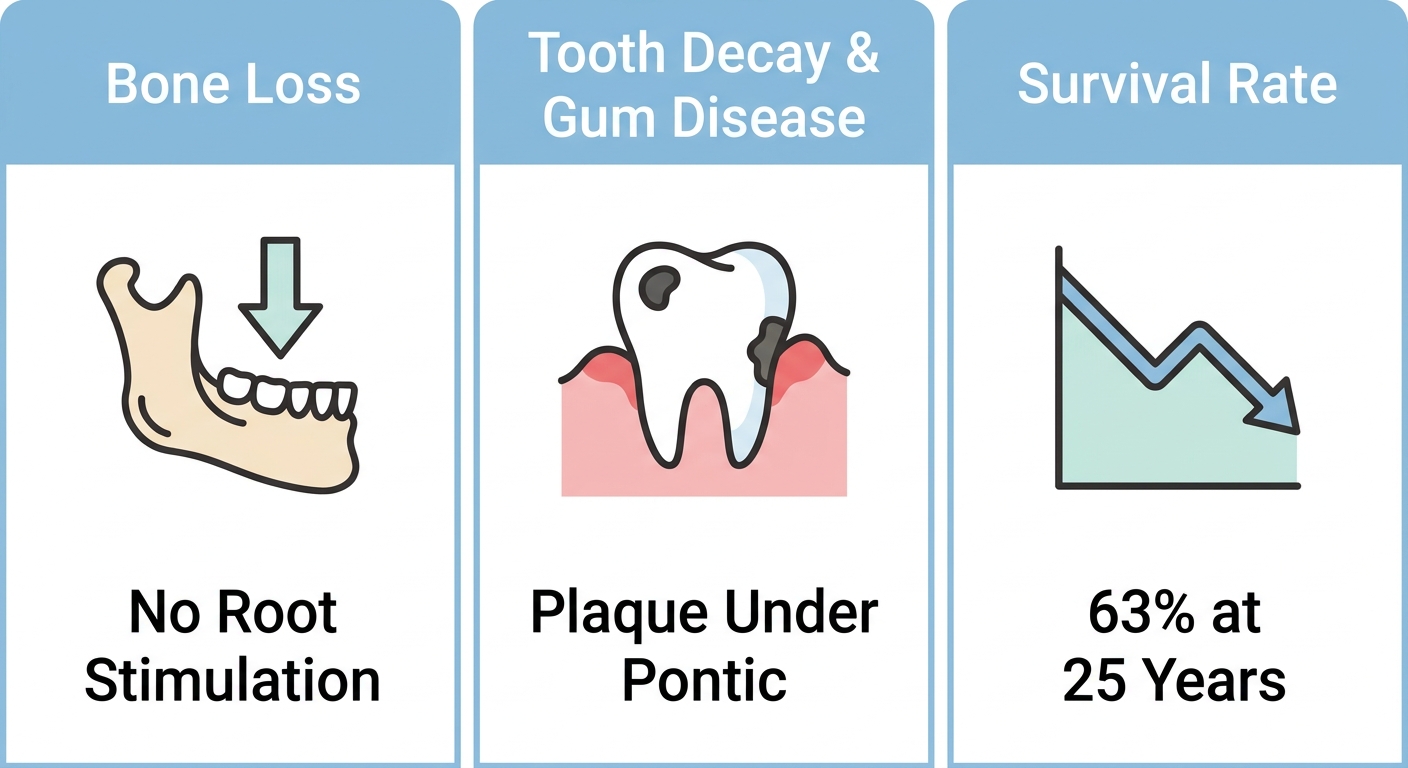
The ADA’s long-term research showed tooth-supported bridges carry significant biological risks, finding a 63% survival rate over 25 years. Unlike an implant that fuses with the bone, a bridge does not replace the tooth root and therefore does not stimulate the jaw bone. They rest on the tooth but don’t replace the tooth roots like an implant. This results in resorbtion or breakdown of jaw bone under a missing tooth without chewing pressure. Over time, this lack of stimulus leads to bone resorption that can alter facial contours and weaken adjacent teeth. In addition, due to inflammatory responses associated with the gums, the bone tends to break down faster than the body has the opportunity to rebuild it back. Finally, when there isn’t anything there for the biting forces to go through, the bone might become weak and its bulk decreased making the implant a possibility a problem in the future.
The Risk of Tooth Decay and Gum Disease Around Bridges
Food debris and bacterial plaque can easily accumulate under the pontic and around the crowned abutment teeth, creating a breeding ground for decay and gum disease—the top biological complications in the ADA study. This buildup fuels decay at the margins of the crowns and triggers gum inflammation. Once decay reaches the abutment tooth’s nerve, it often requires root canal treatment or leads to abutment loss. Because biological problems overshadow technical failures, a bridge’s longevity depends on thorough plaque control. The study showed that patients who stuck to a maintenance program had far fewer failures. We coach our patients at our clinic on flossing and interdental brushes designed for cleaning beneath the pontic, and we emphasize regular professional cleanings to catch early problems.
Below is a list that describes how the bridges differ from implants according to ADA data.
| Aspect | Dental Bridge | Dental Implant |
|---|---|---|
| Survival rate after 25 years | 63% | — |
| Primary cause of failure | Biological (carious lesions, periodontitis) | — |
| Technical failure rate | Lower risk than biological complications | — |
| Importance of patient maintenance | Critical for long-term survival | — |
Although the ADA study did not directly compare implants for these specific measures, the bridge’s 63% survival rate highlights how imperative it is for Squamish patients to maintain bridges to catch early decay or inflammation before it threatens abutment teeth.
What Long-Term Studies Reveal About Bridge Durability
A 63% survival rate was reached according to ADA’s 25-year longitudinal study which followed 40 subjects and concluded that biological factors and not material failure such as fracture were responsible for the loss of abutments. The researchers discovered more positive results when the patients maintained their bridge. It may seem surprising that this kind of tooth supported restoration can still last many years. But again, the bridge will last many years only with rigorous, ongoing care. At the clinic we would be glad to assist in creating an easy-to-follow homecare regime that we can integrate into your current lifestyle, making sure you attend routinely for oral health check-ups.
The biological and durability results demonstrate that if patients want their dental bridges to last for years in their mouth, they’ll have to take great care of them, and that’s where our team comes in. At the clinic, we work hard to help you preserve your oral health with exceptional dentistry with a personal touch.
Maintaining Your Dental Bridge: Cleaning, Care, and Durability
The longevity and oral-health impact of a dental bridge hinge far less on the restoration itself than on the daily habits and professional follow-up that surround it. Even a precisely fitted bridge creates spaces that trap food, plaque, and bacteria, and without a focused cleaning routine those hidden areas can quickly undermine the supporting teeth. Patients who treat home care and regular check-ups as non-negotiable parts of their bridge experience are the ones who enjoy the most predictable, long-lasting results.
Daily Cleaning Techniques for a Dental Bridge
To clean a fixed bridge properly, brush your teeth two times daily with a soft-bristled toothbrush; it cleans visible surfaces but cannot reach underneath the pontic where debris accumulates. Floss threaders allow you to guide normal dental floss beneath the bridge, sliding it along each abutment tooth and under the pontic to dislodge trapped particles. A type of super floss contains a firm end, spongy middle, and typical dental floss, making cleaning faster for some people.
Interdental brushes may be inserted either on the cheek side or on the tongue side under the bridge, enabling users to clean plaque from interdental areas which regular dental floss may miss. The water flosser offers another means for effective cleaning, as water jets are sent between the abutment and teeth by this device. Debris is flushed away into the gap and the gum tissue around the abutments is massaged gently. Users should use the water flosser at least once per day, then follow up with traditional flossing or superfloss, because the water stream alone may not remove the sticky biofilm that adheres to enamel.
Professional Maintenance and Check-Up Schedule
Home care starts things off well enough, but professional eyes will spot anything that home care may have missed. At our practice, we recommend that all of our bridge patients see us for regular check-up and cleaning at least twice per year, although some people might need to come in more often, like every three or four months if their gums aren’t healthy and they’re at higher risk for cavities. Either way, our dental hygienist and dentist look at how much of the margin of the bridge has met up with the natural tooth, lightly probe around to determine if there’s good tissue attachment, find out if there’s any early decay underneath the crowns and test whether the cement holding everything together still looks solid.
This routine effort is aimed at biological threats, caries and periodontal disease, before either becomes dangerous for the abutment tooth. The ADA long-term fixed-prosthesis study shows that well-defined maintenance programs are associated with improved long-term results, as biological complications, not mechanical breakdowns, are the main reasons why the abutments become lost. With a team providing complete dental care, each patient visit offers the potential to extend the lifespan of the bridge instead of just responding to problems.
Expected Lifespan and Repair Frequency
How long does a dental bridge last? It depends upon patient compliance, abutment status, and continuous supervision by a dentist. Over a 25-year time frame longitudinal data in the ADA’s analysis found a 63% survival rate for tooth-supported fixed dental prostheses, and good outcomes were more likely if patients adhered to their maintenance program.
Cement failure may allow seepage that leads to sensitivity or early decay; if caught promptly, a bridge can often be recemented. Minor porcelain chips or wear on chewing surfaces can frequently be repaired intraorally. More serious problems occur when recurrent decay undermines an abutment tooth or when periodontitis erodes supporting bone to the point that the foundation is no longer reliable—at that stage full replacement, and sometimes additional restorative work, becomes necessary.
Whichever route you choose, the group from Squamish will assist in weighing all options, formulate a care plan that fits your life, and support your oral health at every stage.
Weighing Bridges Against Dental Implants and Other Options
Understanding what is the downside of a dental bridge helps patients in Squamish decide if an alternative suits them better. At our practice, we offer all three options — dental implants, implant-supported restorations, and partial dentures.
According to long-term clinical data from the American Dental Association (ADA), the most common cause of tooth-supported bridge failure in patients is biology rather than engineering. This 25-year study demonstrated that abutment teeth were more likely to be lost due to biological factors, including carious lesions on abutments and advancing periodontal disease compared to other types of failure like chipped restorations or loss of retention. During this time frame, only about half (63%) of tooth-supported fixed dental prostheses remained in service after 25 years, which means that these bridges often require treatment again despite regular care.
In this way, dental implants deal with such biological problems by replacing the tooth root and fusing with the jaw bone. They don’t need neighbouring teeth to support them.
They’re non-invasive alternatives that are easily taken out. Partial dentures aren’t as stable while chewing and can irritate your soft tissues if there are any clasps in them. If you have partials, they must be removed each day for cleaning.
Bridge Downsides in Context: How Alternatives Compare
| Feature | Traditional Bridge | Implant-Supported Crown | Partial Denture |
|---|---|---|---|
| Longevity (typical range) | 63% survival at 25 years per ADA data | Often exceeds 90% at 10 years (general data) | 5–10 years with good care |
| Main cause of failure | Biological complications – decay and gum disease on abutments | Implant fracture or peri-implantitis | Clasp breakage or gum irritation |
| Effect on adjacent teeth | Relies on abutment teeth; carries risk of decay and periodontal breakdown | Independent; preserves neighbouring teeth entirely | Clasps may gradually wear on anchor teeth |
| Maintenance needs | Requires careful cleaning under the pontic and around abutments | Brushed like a natural tooth with periodic professional maintenance | Removed daily for cleaning, requires soaking |
| Invasiveness of procedure | Non-surgical tooth preparation | Surgical placement required | Non-surgical; removable |
Frequently Asked Questions About Dental Bridges
One common question patients ask us in Squamish is what the downside of a dental bridge is. The main drawback is that healthy adjacent teeth must be reshaped to support the bridge, which permanently alters them and can increase the risk of decay or future damage. A bridge remains a reliable and attractive tooth replacement.
A dental bridge can last between ten to fifteen years if you take good care of it by brushing your teeth properly, flossing under the pontic daily, and getting regular checkups. How long does a dental bridge last, and how do I care for it?
Is getting a dental bridge painful? We use local anesthesia to keep you comfortable, so getting a bridge feels no worse than a standard filling.
The responses above may assist you in determining whether a bridge is suitable for you. Afterward, we’ll delve into what lies ahead on your journey towards achieving that perfect smile.
FAQ
Do dental bridges prevent bone loss in the jaw like dental implants do?
No, dental bridges do not prevent bone loss in the jaw. Unlike dental implants, a bridge does not replace the tooth root and therefore fails to stimulate the jaw bone. The lack of chewing pressure leads to bone resorption, which can alter facial contours and weaken neighboring teeth over time.
Can Dental Bridges Increase the Risk of Tooth Decay or Gum Disease?
Yes, dental bridges can increase the risk of tooth decay and gum disease. Food debris and bacterial plaque accumulate under the pontic and around abutment teeth, creating a breeding ground for cavities and periodontal inflammation. The American Dental Association study identified these biological complications as the leading cause of bridge failure.
Does Getting a Dental Bridge Require Filing down Healthy Adjacent Teeth?
Yes, a traditional dental bridge requires filing down the healthy adjacent teeth. These teeth are reshaped to serve as anchors for the crowns that support the artificial tooth. The Canadian Dental Association identifies this as a necessary step in the bridge procedure.
Your Next Steps Toward a Healthy Smile in Squamish
Now that you have a clearer picture, you might still wonder what the downside of a dental bridge is, and that’s a wise question. The American Dental Association notes biological complications such as caries and gum disease are the main long-term risks to bridges, but these are manageable with consistent home care and routine professional maintenance. As a family-focused practice, we provide honest guidance and a maintenance plan. Contact our clinic in Squamish at (604) 892-5966 or visit 201-37994 2nd Avenue to book a consultation.
Book Your Bridge Consultation in Squamish
Now that you’ve explored the complete downsides of dental bridges, from biological complications like decay and gum disease to the 63% survival rate after 25 years, it’s time to consider your next step. The research underscores that patient maintenance is critical for long-term success. At our practice in Squamish, we offer personalized consultations to discuss whether a bridge, implant, or alternative option suits your needs. We’ll help you weigh the trade-offs and create a care plan tailored to your oral health goals. Call us at (604) 892-5966 to schedule your appointment. Our team looks forward to guiding you toward a confident smile.
Book Your Bridge Consultation in Squamish


